2.1
Sentinel-2 and Planet Scope data, Vegetation indices
(Approx. 30 min reading incl. references)
The high-resolution optical data acquired from free available Sentinel-2 or commercial Planet Scope SuperDove satellites, offer the possibility to monitor crop growth at the sub-field level, making them highly interesting for applications within heterogeneous landscapes, cultivars and management practices (Bolton et al. 2020; Cheng et al. 2020; Jönsson and Eklundh 2002). However, the sensitivity of optical sensors to weather conditions reduces the availability of valid observations. Here, daily revisit time and high spatial and spectral resolution of Planet Scope data, arise great interest in the land system science community to fill gaps in data time series.
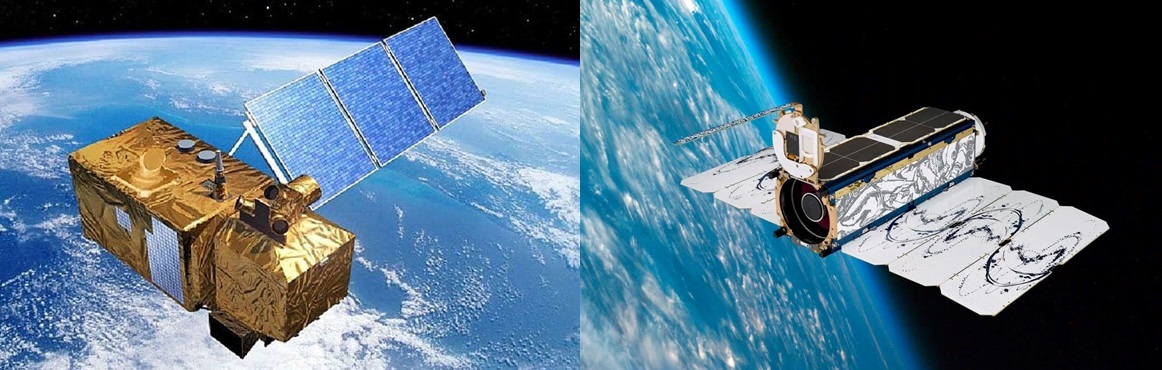
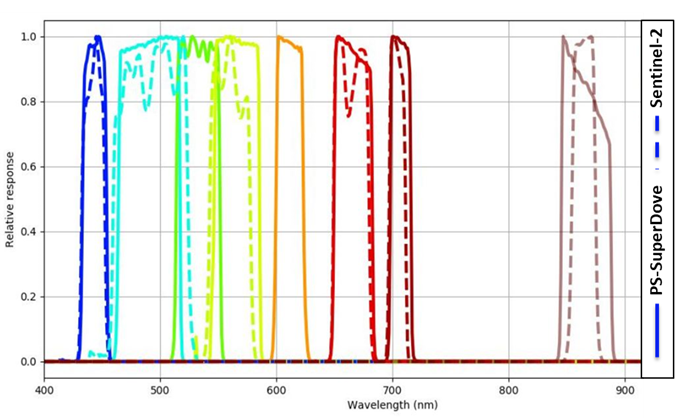
The Copernicus Sentinel-2 mission provides image products within various preprocessing baselines (Level-1C, Level-2A), which corresponds to image preprocessing steps related to the radiometric and geometric correction, and classification. The Level-1C data refers to the Top-Of-Atmosphere (TOA) orthoimage products. The Level-2A processing baseline includes a Scene Classification and an Atmospheric Correction applied to Level-1C and provides output atmospherically corrected Surface Reflectance and Classification products. Using near-simultaneous S2 data for a more robust TOA vicarious calibration, the spectral response functions of Planet Scope SuperDove and the individual S2 bands exhibit a high degree of correspondence, potentially allowing them to be used interchangeably (Collison et al. 2022).
Sentinel-2 and Planet Scope Surface Reflectance products (Level-2A and Level-3B, respectively) are applied to calculate Vegetations Indices (VI), extracted from different spectral bands. In general, VIs are used as plant greenness proxies (Jönsson and Eklundh 2002; Vrieling et al. 2017; Zeng et al. 2020) to monitor vegetation growth and health status, while some of them have been used to track plant phenological changes.
A broad spectrum of satellite-derived vegetation indices has been applied for phenological applications, as for example frequently used Normalized Difference Vegetation Index (NDVI) (Rouse et al. 1973), the Enhanced Vegetation Index (EVI and EVI2) (Bolton et al. 2020; Huete et al. 2002) or the Plant Phenology Index (PPI) (Jin and Eklundh 2014). While certain VIs are characterized by specific advantages and limitations, e.g. NDVI saturates at the high biomass (Asrar et al. 1984; Huete 1988) or EVI can be sensitive to snow (Jin and Eklundh 2014), there is no single superior VI and selection needs to be suited to specific phenological phase and crop type (Main-Knorn, et al, in review).
In this lecture following VIs were selected:
| Index | Name | Formula | Developed by |
|---|---|---|---|
| NDVI | Normalized Difference Vegetation Index | NDVI = (NIR – Red)/(NIR + Red) | Tucker (1979) |
| NDPI | Normalized Difference Phenology Index | NDPI = (NIR − (0.74 * Red + 0.26 * SWIR)) / (NIR + (0.74 * Red + 0.26 * SWIR)) | Wang et al. (2017) |
| NDRE | Normalized Difference RedEdge Index | NDRE = (NIR – RedEdge)/(NIR + RedEdge) | Gitelson et al. (2005) |
| MSAVI | Modified Soil Adjusted Vegetation Index | MSAVI = (2 * (NIR + 1) - sqrt((2 * NIR + 1)^2 - 8 * (NIR - Red))) / 2 | Qi et al. (1994) |
The NDVI is considered the standard indicator of vegetation productivity related to green biomass and surface phenology, especially for the early stages of plant development. As plant development progresses and biomass increases, the NDVI reaches a saturation point and may therefore no longer adequately describe plants in the mid-to-late stages of development. Therefore, some authors consider using NDRE (Kang et al. 2021), a RedEdge-based index that is highly sensitive to chlorophyll content and phenological development, and, in comparison with NDVI shows larger relative difference in plant seasonal maximum (August/September). MSAVI has been used by some authors to monitor changes in sparse vegetation (del Rio et al. 2024; Liaqat et al. 2017) because it is less sensitive to soil background effects, including wet/dry soil conditions (where NDVI is more sensitive), and has a stronger correlation with early plant growth stages. Finally, the SWIR-based NDPI was selected due to its strong correlation with LAI, sensitivity to leaf water content and sparse vegetation with high soil background, and its resistance to the effects of snow cover.
References
- Asrar, G., et al., Estimating Absorbed Photosynthetic Radiation and Leaf-Area Index from Spectral Reflectance in Wheat. Agronomy Journal, 1984. 76(2): p. 300-306.
- Bolton, D.K., Gray, J.M., Melaas, E.K., Moon, M., Eklundh, L., Friedl, M.A. (2020) Continental-scale land surface phenology from harmonized Landsat 8 and Sentinel-2 imagery. Remote Sensing of Environment 240.
- Cheng, Y., Vrieling, A., Fava, F., Meroni, M., Marshall, M., Gachoki, S. (2020) Phenology of short vegetation cycles in a Kenyan rangeland from PlanetScope and Sentinel-2. Remote Sensing of Environment 248.
- Collison, A., A. Jumpasut, and H. Bourne, On-orbit Radiometric Calibration of the Planet Satellite Fleet, P. Planet Labs, Editor. (2022): (https://assets.planet.com/docs/ radiometric_calibration_white_paper.pdf, accessed 19 February 2025).
- del Rio, M.S., Cicuéndez, V., Yagüe, C. (2024) Characterisation of Two Vineyards in Mexico Based on Sentinel-2 and Meteorological Data. Remote Sensing 16.
- Gitelson, A.A., et al. (2005), Remote estimation of canopy chlorophyll content in crops. Geophysical Research Letters, 32, 8.
- Huete, A., Didan, K., Miura, T., Rodriguez, E.P., Gao, X., Ferreira, L.G. (2002) Overview of the radiometric and biophysical performance of the MODIS vegetation indices. Remote Sensing of Environment 83, 195-213.
- Huete, A.R. (1988) A Soil-Adjusted Vegetation Index (Savi). Remote Sensing of Environment 25, 295-309.
- Jin, H.X., Eklundh, L. (2014) A physically based vegetation index for improved monitoring of plant phenology. Remote Sensing of Environment 152, 512-525.
- Jönsson, P., Eklundh, L. (2002) Seasonality extraction by function fitting to time-series of satellite sensor data. Ieee Transactions on Geoscience and Remote Sensing 40, 1824-1832.
- Kang, Y.P., Hu, X.L., Meng, Q.Y., Zou, Y.F., Zhang, L.L., Liu, M., Zhao, M.F. (2021) Land Cover and Crop Classification Based on Red Edge Indices Features of GF-6 WFV Time Series Data. Remote Sensing 13.
- Liaqat, M.U., Cheema, M.J.M., Huang, W.J., Mahmood, T., Zaman, M., Khan, M.M. (2017) Evaluation of MODIS and Landsat multiband vegetation indices used for wheat yield estimation in irrigated Indus Basin. Computers and Electronics in Agriculture 138, 39-47.
- Qi, J., Chehbouni, A., Huete, A.R., Kerr, Y.H., Sorooshian, S. (1994) A Modified Soil Adjusted Vegetation Index. Remote Sensing of Environment 48, 119-126.
- Rouse, J.W., Haas, R.H., Schell, J.A., Deering, D.W., (1973) Monitoring vegetation systems in the great plains with ERTS.
- Tucker, C.J. (1979) Red and photographic infrared linear combinations for monitoring vegetation. Remote Sensing of Environment 8, 127-150.
- Vrieling, A., Skidmore, A.K., Wang, T.J., Meroni, M., Ens, B.J., Oosterbeek, K., O'Connor, B., Darvishzadeh, R., Heurich, M., Shepherd, A., Paganini, M. (2017) Spatially detailed retrievals of spring phenology from single-season high-resolution image time series. International Journal of Applied Earth Observation and Geoinformation 59, 19-30.
- Wang, C., et al., (2017) A snow-free vegetation index for improved monitoring of vegetation spring green-up date in deciduous ecosystems. Remote Sensing of Environment. 196: p. 1-12
- Zeng, L.L., Wardlow, B.D., Xiang, D.X., Hu, S., Li, D.R. (2020) A review of vegetation phenological metrics extraction using time-series, multispectral satellite data. Remote Sensing of Environment 237.