2.3.
LSP definition and retrieval methods
(Approx. 30 min reading incl. references)
Satellite image Time series can provide valuable information about plant growth and development over time. However, this input does not allow to detect specific phenological phases of particular plants defined by agronomists and used for crop model simulations. To overcome this limitation, scientists have developed a concept called Land Surface Phenology (LSP) (Reed et al. 1994). The LSP metrics represent the aggregated phenological dynamics of vegetation at pixel resolution (Soubry et al. 2023).
Now, dense satellite time series enable to identify and extract the timing of the main phenological transition dates during the growing season (Bolton et al. 2020), commonly associated with the Start-, Peak- and End-of-Season, (SoS, PoS, EoS respectively), growing season length and the maximum growth magnitude.
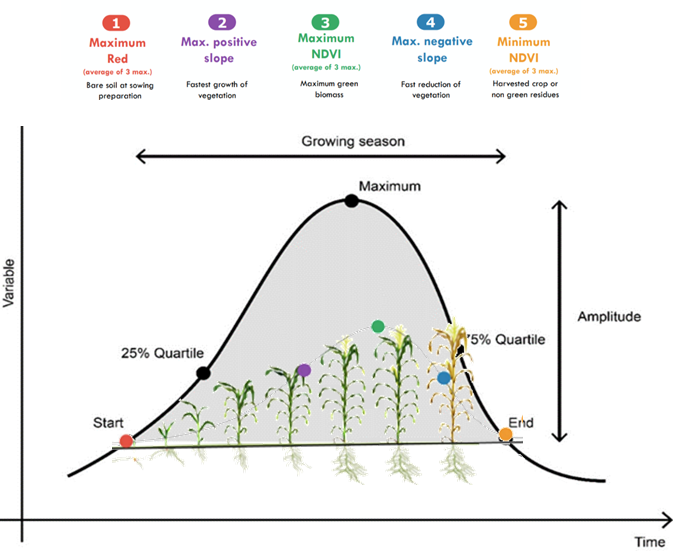
Prior to extracting phenometrics (LSP metrics), it is essential to preprocess the VI time series to minimize the impact of artefacts on the temporal pattern and ensure accurate LSP retrieval. This involves the following steps: masking low-quality pixels, filling pixel gaps, interpolating, and smoothing the data to reduce the effects of cloud cover, cloud shadows, and other noise sources. A variety of state-of-the-art curve fitting and smoothing methods have been developed, including the Savitzky-Golay filter (Jönsson and Eklundh 2004; Savitzky and Golay 1964), the double logistic function (Julien and Sobrino 2009), the B-spline function (Cai et al. 2017; Qader et al. 2023; Zhang et al. 2022), and the asymmetric Gaussian function (Jönsson and Eklundh 2002). Due to their flexibility in fitting irregular VI time series and effectively handling high-frequency noise and data gaps due to cloud cover, the latter two methods become increasingly popular in LSP modelling.
The extraction methods of phenometrics from RS time series can be classified into three main categories: threshold-based (widely used), derivative-based, and autoregressive moving average methods. All three categories demonstrate gains and limitations: the threshold-based methods are intuitive and efficient but sensitive to noise, the derivative-based methods accurately detect transition points in time series but are vulnerable to noisy datasets and require pre-smoothing, the autoregressive moving average methods are robust to noise and effective at capturing complex seasonal patterns but computationally intensive. One of the widely used software designed to analyse RS time series and extract phenological LSP metrics is the TIMESAT software (Eklundh and Jönsson 2016). It is particularly valued for employing different smoothing, fitting and retrieval methods to derive LSP. Nevertheless, its applicability is limited in cases of sparse, irregular time series or complex landscapes.
LSP metrics are calculated for each pixel using fitted, annual VI time series. Specifically, the LSP is derived from the minimum of left- and right- side fitted VI values, the maximum VI value, the base, and the amplitude of the curve. The peak of the growing season (PoS) is determined based on 90% of the maximum VI value in each pixel, as recommended by Meroni et al. (2021). The start and end of the growing season (SoS and EoS) are extracted using four distinct methods, including the First-of-Slope approach, which identifies the first positive and first negative difference in VI values for SoS and EoS respectively, the Median approach, which uses the median VI value of the left- and right slopes, the Seasonal-Amplitude approach, which takes into account 0.25 of the amplitude from the base, and the Relative-Amplitude approach, which utilizes the 90th and 10th percentiles of VI values. All phenometrics are expressed in terms of day-of-year (DOY).
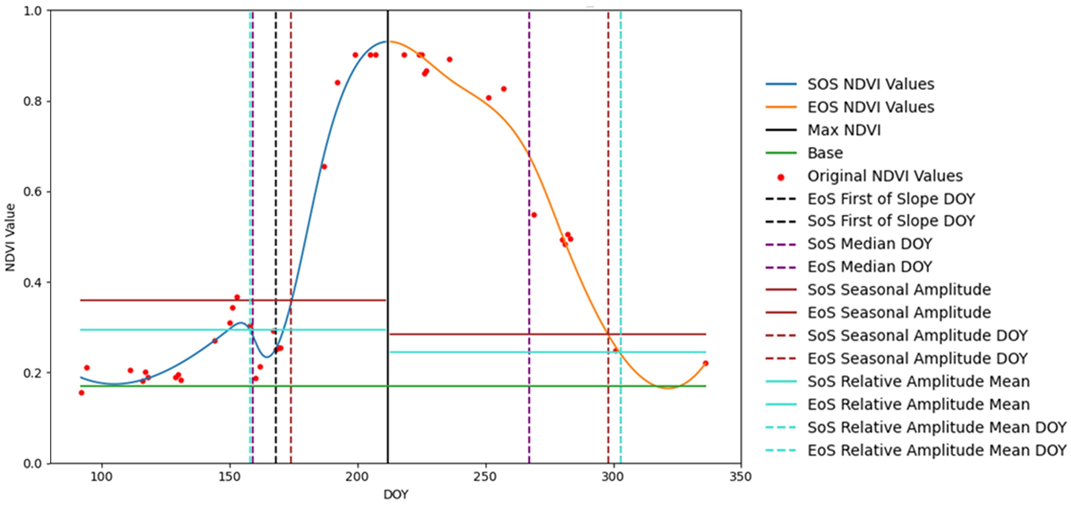
In the practical part of this lecture, the application of the B-spline fitting function and two phenometrics retrieval methods (Median and Relative-Amplitude) are demonstrated.
References
- Bolton, D.K., Gray, J.M., Melaas, E.K., Moon, M., Eklundh, L., Friedl, M.A. (2020) Continental-scale land surface phenology from harmonized Landsat 8 and Sentinel-2 imagery. Remote Sensing of Environment 240.
- Cai, Z.Z., et al., (2017) Performance of Smoothing Methods for Reconstructing NDVI TimeSeries and Estimating Vegetation Phenology from MODIS Data. Remote Sensing. 9(12).
- Eklundh, L. and P. Jönsson, (2016) TIMESAT for Processing Time-Series Data from Satellite Sensors for Land Surface Monitoring, in Multitemporal Remote Sensing: Methods and Applications, Y. Ban, Editor., Springer International Publishing: Cham. p. 177- 194.
- Jönsson, P., Eklundh, L. (2004) TIMESAT - a program for analyzing time-series of satellite sensor data. Computers & Geosciences 30, 833-845.
- Jönsson, P., Eklundh, L. (2002) Seasonality extraction by function fitting to time-series of satellite sensor data. Ieee Transactions on Geoscience and Remote Sensing 40, 1824-1832.
- Meroni, M., d'Andrimont, R., Vrieling, A., Fasbender, D., Lemoine, G., Rembold, F., Seguini, L., Verhegghen, A. (2021) Comparing land surface phenology of major European crops as derived from SAR and multispectral data of Sentinel-1 and-2. Remote Sensing of Environment 253.
- Reed, B.C., Brown, J.F., Vanderzee, D., Loveland, T.R., Merchant, J.W., Ohlen, D.O. (1994) Measuring Phenological Variability from Satellite Imagery. Journal of Vegetation Science 5, 703-714.
- Savitzky, A., Golay, M.J.E. (1964) Smoothing and Differentiation of Data by Simplified Least Squares Procedures. Analytical Chemistry 36, 1627-1639.
- Soubry, I., Manakos, I., Kalaitzidis, C., (2023) Progress on Land Surface Phenology Estimation with Multispectral Remote Sensing, in: Grueau, C., Laurini, R., Ragia, L. (Eds.), Geographical Information Systems Theory, Applications and Management. Springer Nature Switzerland, Cham, pp. 16-37.
- Qader, S.H., et al., (2023) Exploring the use of Sentinel-2 datasets and environmental variables to model wheat crop yield in smallholder arid and semi-arid farming systems. Science of the Total Environment. 869.
- Zhang, T., et al., (2022) Gap-filling MODIS daily aerosol optical depth products by developing a spatiotemporal fitting algorithm. Giscience & Remote Sensing. 59(1): p. 762- 781.