Lesson 2
Digital Soil Mapping Procedure for Precision Agriculture Implementation Assisted by a Mechanistic Model
Overview
1. Concept
Digital Soil Mapping (DSM) aims to predict soil properties continuously across space using a combination of ground measurements and environmental covariates (e.g., remote sensing, DEM, land use).
While numerous DSM methods exist in scientific literature, no single standardized workflow has proven reliable across different contexts, especially when ground data availability varies widely.
This course introduces a scalable DSM framework that remains functional and reliable under diverse data conditions, from fields with very few soil samples (~20 profiles) to those with extensive sampling (>50 profiles).
The method is designed to be usable by both farmers and scientists, promoting practical adoption of Precision Agriculture (PA) techniques.
In the end of this course, the attendant will be able to implement the proposed DSM procedure into any arable field.
2. Objectives
After completing this module, participants will be able to: Construct digital soil maps for agricultural fields regardless of the amount of ground truth data available.
Understand how data quantity affects model complexity and expected accuracy.
Apply an incremental modeling approach: start simple, refine with more data.
Accuracy scales with data quantity:
Few samples → lower accuracy
More samples → higher accuracy (same framework)
3. Workflow Overview
| Data Availability | Recommended Approach | Output |
|---|---|---|
| No ground data | Use global products such as CUP4Soil to obtain soil property estimates. | Reference DSM (low resolution) |
| Few data (~20 profiles) | Fit a Linear Model (e.g., multiple regression) using selected covariates to create a Coarse DSM. | Baseline local DSM |
| Many data (>50 profiles) | Apply a Random Forest model to correct residuals of the linear model → Hybrid DSM combining interpretability and high accuracy. | Accurate DSM for PA |
4. Key Features
- Scalable: One workflow adaptable to any data size.
- Interpretable: Linear base model retains physical meaning.
- Upgradable: More data automatically improves performance.
- Practical: Implementable using open tools (Python Anaconda, QGIS).
- Goal-Oriented: Facilitates reliable input generation for precision agriculture decisions.
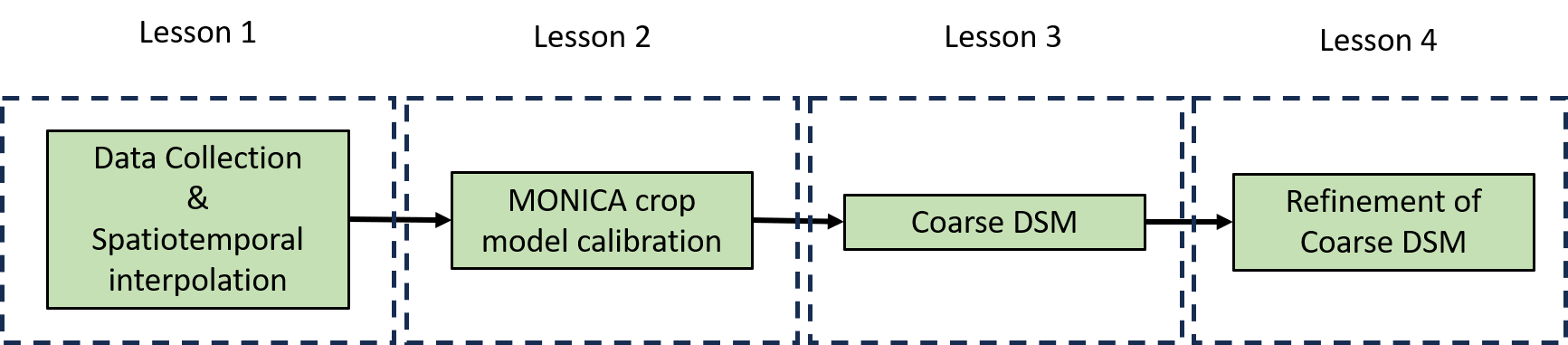
Workflow of the course through 4 lessons:
Contributors:
Dr. Leonardo Inforsato (Contact: )
Dr. Magdalena Main-Knorn
Dr. Gohar Ghazaryan