Section 1
Overview: From theory to practice
In the previous two lectures, we explored the theoretical foundations of applying deep learning to small remote sensing datasets in agriculture. We discussed various strategies, including supervised learning, transfer learning, self-supervised learning, ensemble methods, and spatial validation techniques.
This practical module provides hands-on experience with those techniques using real-world remote sensing data from the LUCAS (Land Use and Cover Area Frame Survey) dataset. The goal is to bridge the gap between abstract theory and executable workflows, offering learners clear, modifiable code examples and opportunities to explore model performance under constrained data settings.
We will work through a set of Jupyter Notebooks, starting with a traditional supervised learning model and progressing through several SSL techniques, including MoCo, SimCLR, and SimSiam. These methods are particularly valuable when large labeled datasets are unavailable or costly to obtain, a common scenario in agricultural monitoring across diverse regions.
Technical setup
System requirements:
- Python 3.8+
- Jupyter Notebook or JupyterLab environment
- A computer with GPU support (recommended but not required)
Wired Python libraries could be installed using the command as:
pip install torch torchvision pytorch-lightning lightly scikit-learn numpy pandas matplotlib opencv-python pillow torchsummary notebookwhere, these packages include tools for:
- Model training (torch, torchvision)
- Advanced training strategies (pytorch-lightning)
- Self-supervised learning utilities (lightly)
- Data visualization and utilities (matplotlib, numpy, opencv-python, pandas)
- Model summaries (torchsummary)
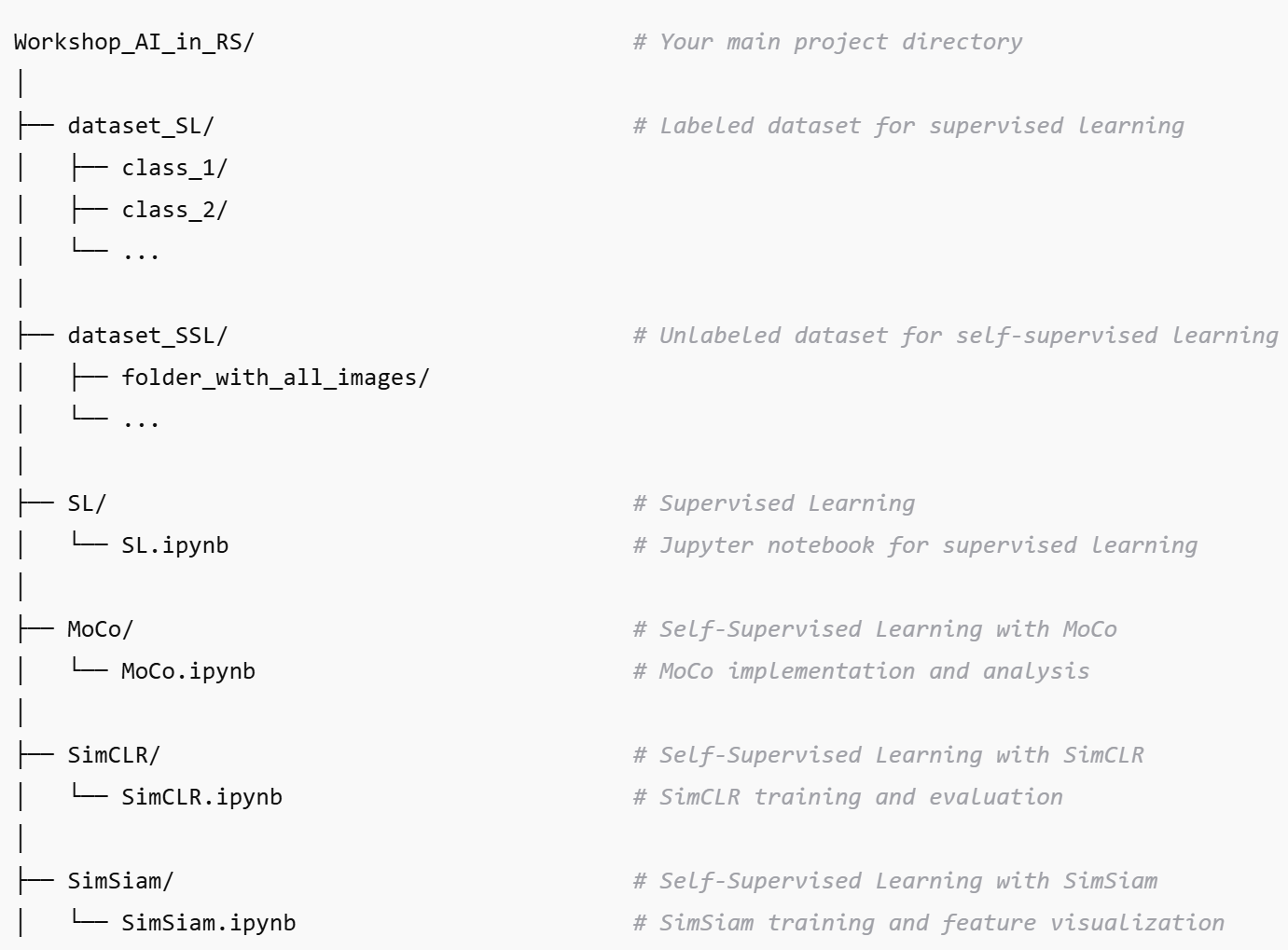
Before running the networks, make sure your local environment follows this file structure:
Code & datasets:
https://1drv.ms/f/c/e7195996584dae14/El7Y8vfDjDFJie1hEyUCY1IB6ap0Mo8dgzzk42DlD3-M9w?e=pQDKkH.
Folder details:
dataset_SL_1 contains the labeled image data organized in class folders. This dataset is used for training and evaluating the supervised model in SL.ipynb.
dataset_SSL_1 contains unlabeled images in a single folder or loosely structured format. These are used by the self-supervised methods (MoCo, SimCLR, SimSiam).
SL, MoCo, SimCLR, SimSiam contain one Jupyter Notebook specific to that method. You will work with these one by one during the practical sessions. They can be modified to include your own datasets or parameters.