2.4.
Maize phenological stages and the BBCH Plant Classification System
(Approx. 30 min reading incl. references)
The phenological development of crops is described and codified in specified development stages in order to create standardized descriptions across languages and disciplines in agricultural plant research (Meier, 2018). The widely known BBCH-Code (abbreviation of Biologische Bundesanstalt, Bundessortenamt und CHemische Industrie) was developed based on the Zadoks scale (Zadoks et al., 1974).
The principal growth stages of the maize plant, according to the BBCH classification, begin with germination, which is the sprouting of the plant from the seed. Leaf development ensues, which includes the formation of up to nine leaves. The next stage, tillering, describes the growth of lateral offshoots from the base of the plant, which is generally absent or minimal in maize. Stem elongation describes vegetative growth up to the unfolding of the flag leaf (top leaf); during this stage, rapid plant growth takes place. Booting describes the flag leaf sheath thickening and opening as the plant prepares to produce tassels or ears. The heading or tassel emergence describes the emergence of the tassel, which is the male flower of the plant. The flowering stage is when the anthers, the pollen-producing parts on the tassel, become visible and open. The subsequent stages involve the development and the ripening of the grains. The kernels form, fill, and harden during ripening, which is also known as dough ripening. The final growth stage is senescence in which the grains can become overripe, and the plant eventually dies (Meier, 2018).
The BBCH scale is associated with the code system used by the German Meteorological Service (Deutscher Wetterdienst - DWD) to collect phenological data through volunteer-based, on-the-ground visual observations. For instance, the DWD publishes nationwide observations of tip-of-tassel emergence, start of flowering and silage harvest, amongst others (Deutscher Wetterdienst, https://www.dwd.de/DE/leistungen/phaeno_akt/phaenoakt.html).
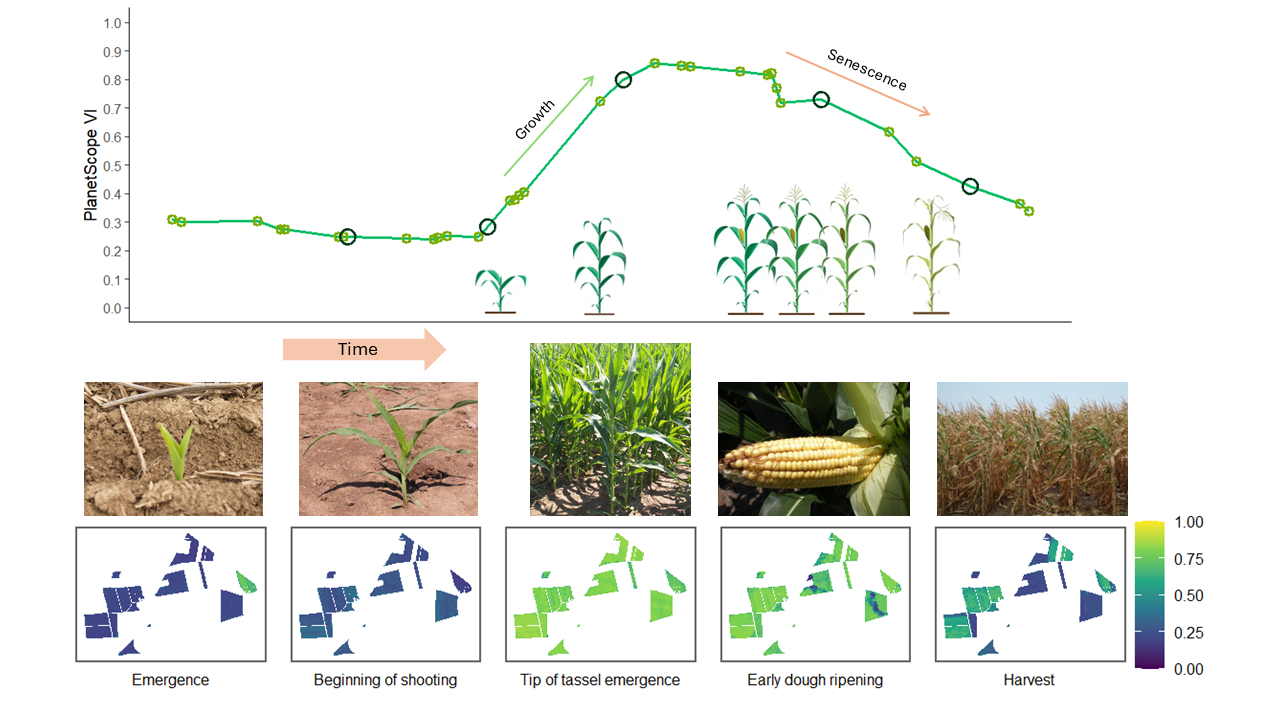
Reference Fotos:
- Kansas State University (2024). Corn Growth and Development. Department of Agronomy. https://www.agronomy.k-state.edu/extension/crop-production/corn/corn-growth-development.html.
- Ritchie, S.W., J.J. Hanway, and G.O. Benson. (1993) How a corn plant develops. Spec. Rep. 48 (revised). Iowa State Univ. of Sc. and Technol. Coop. Ext. Serv., Ames, IA.
Maize graphics:
- MAS Seeds (2025) Key Growth Stages of Maize: The 8 key growth stages of maize for crop management. https://masseeds.com/agro-library/key-growth-stages-of-maize/.
References
- Meier, U. (2018) Growth Stages of Mono and Dicotyledonous Plants. BBCH Monograph, Federal Biological Research Centre for Agriculture and Forestry, Bonn.
- ZADOKS, J.C., CHANG, T.T. and KONZAK, C.F. (1974) A decimal code for the growth stages of cereals. Weed Research, 14: 415-421. https://doi.org/10.1111/j.1365-3180.1974.tb01084.x