2.1.
Machine learning to fill spatiotemporal data gaps in hydrological monitoring networks
Machine Learning (ML) has emerged as a powerful and versatile approach across almost every scientific and professional discipline. It is capable of handling both structured and unstructured data to address a wide range of analytical tasks, including regression, classification, clustering, and prediction. Over the past decade, ML has demonstrated exceptional performance in diverse fields where spatial aspects play a central role. Applications include land use and land cover classification, spatial and temporal characterization, urban growth and gentrification analysis, disaster monitoring and management, agricultural productivity and crop yield prediction, modeling infectious disease emergence and spread, transportation planning and accident analysis, cartography and map visualization, delineation of geographic regions and habitat mapping, geographic information retrieval and text matching, point-of-interest (POI) and region recommendation systems, movement and trajectory pattern prediction, point cloud classification, spatial interaction modeling , spatial interpolation, and spatiotemporal prediction.
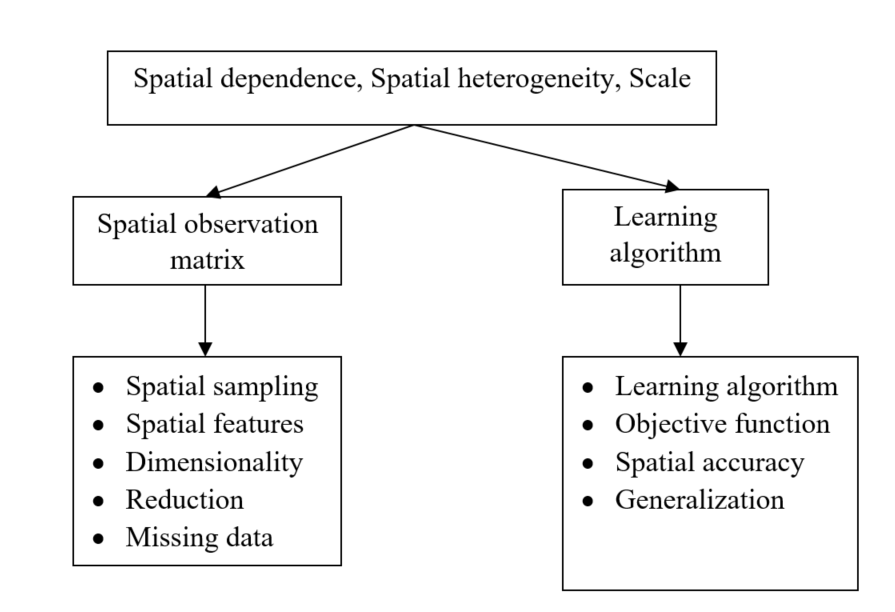
Spatial data possess unique characteristics that distinguish them from other data types most notably spatial dependence, spatial heterogeneity, and scale effects. Spatial dependence (or spatial autocorrelation) implies that observations located near each other are more likely to be similar than those farther apart, violating the assumption of independence that many ML models rely on. Spatial heterogeneity refers to variations in relationships or patterns across geographic space, while scale effects highlight that observed patterns and model performance can vary depending on the spatial resolution or extent of analysis.
When applying ML methods to spatial data, it is therefore essential to explicitly consider these spatial properties during model design, training, and validation. Properly accounting for them can significantly enhance model performance, interpretability, and generalizability, and can also reveal valuable insights about underlying spatial processes. Conversely, neglecting spatial dependence, heterogeneity, or scale may lead to biased estimates, misleading predictions, and reduced model reliability.
To effectively apply machine learning to spatial data, it is essential to incorporate spatial context such as location, distance, and topological relationships into the learning process. Fig. 1 illustrates this process as comprising two key components: the spatial observation matrix and the learning algorithm.